On this page
Before We Begin…
This post was actually drafted in late March 2023, but due to laziness it took about a year before I finally polished it up and uploaded it. So when I say “these days” in this post, I mean late March 2023.
How It All Started
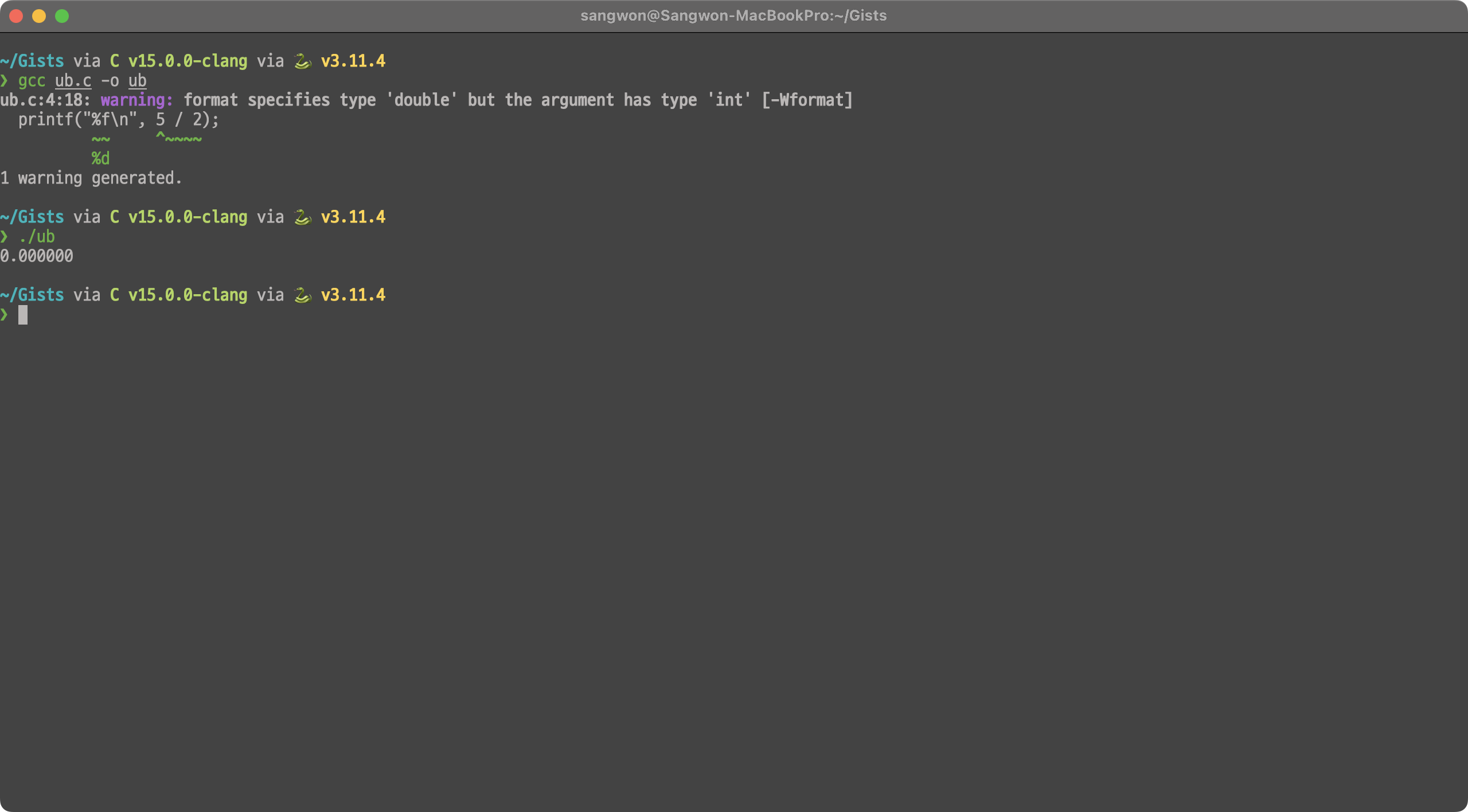
These days I’m learning C at school. I think because the professor finds it hard to differentiate students with just basic C syntax, he’s been teaching a lot of murky material packed with Undefined Behaviour. One day he showed us the following code:
printf("%f", 5 / 2);He explained that since both sides of 5 / 2 are int, the result is the integer 2, not the floating-point 2.5, and that printf expects a double as its second argument because of the %f format specifier — so when an unexpected int is passed instead, 0.0 gets printed.
Hmm, on my computer it does print 0.0…
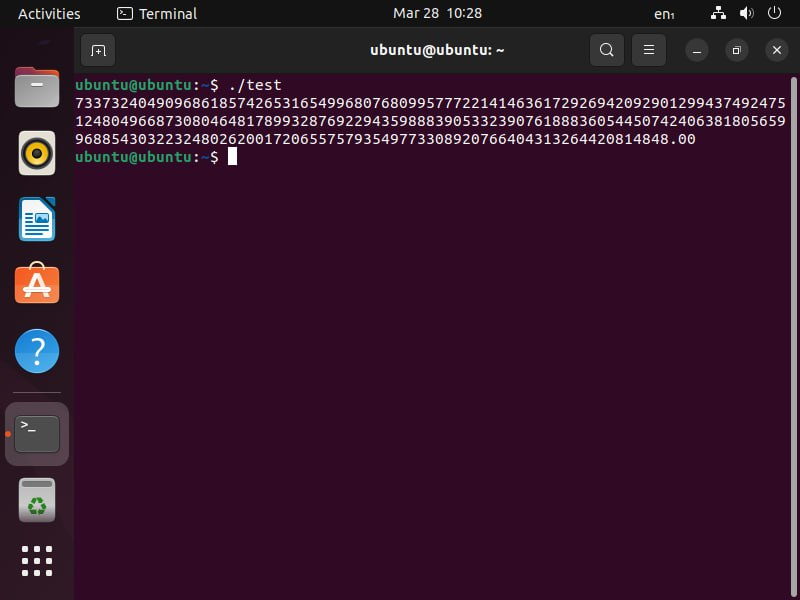
But when run on my friend’s computer, some weird garbage value is printed instead?
Root Cause Analysis
To figure out what factor was causing the different output, I compared the differences between my setup and my friend’s. The Ubuntu version and glibc version were identical. I was on x86-64 macOS, and my friend was running an x86-64 Ubuntu guest on an x86-64 Windows machine. To check whether the macOS vs Ubuntu difference was the cause, I installed an x86-64 Ubuntu guest via Parallels on x86-64 macOS and tested it — and sure enough, my environment still printed 0.0. Wondering if it might be something specific to the VM, I installed VirtualBox (which my friend uses) and ran the same code — and as expected, a garbage value appeared. So I confirmed it was VM-dependent, but exactly which aspect of each VM was causing the different output?
Disassembly
First, since the same binary produces different output depending on which VM runs it, it seemed difficult to trace the cause at the C language level. So I disassembled the binary, and the result is as follows:
; printf(".2f", 5/2)
mov    esi,0x2
lea    rax,[rip+0xea7]
mov    rdi,rax
mov    eax,0x0
call   0x1050 <printf@plt>
5/2 was evaluated to 2 and then baked into the assembly as a constant. In line with the x86-64 calling convention, the first argument "%.2f" is passed in rdi via lea rax, [rip+0xea7] and mov rdi, rax, and the second argument 2 is passed in rsi via mov esi, 0x2. This code is too straightforward to be responsible for the differing output. Something must be happening inside printf.
glibc Analysis
The printf function is implemented in glibc (since this was a freshly installed Ubuntu, it was definitely not something like musl libc). The implementation of printf is as follows:
int __printf (const char *format, ...) {
    va_list arg;
    int done;

    va_start (arg, format);
    done = __vfprintf_internal (stdout, format, arg, 0);
    va_end (arg);

    return done;
}
It handles variadic arguments using va_list, va_start, and va_end. printf itself is just a wrapper; the actual logic lives in __vfprintf_internal. Its implementation is as follows:
// ...

#if __HAVE_FLOAT128_UNLIKE_LDBL
    #define PARSE_FLOAT_VA_ARG_EXTENDED(INFO)                                       \
        do {                                                                        \
            if (is_long_double && (mode_flags & PRINTF_LDBL_USES_FLOAT128) != 0) {  \
                INFO.is_binary128 = 1;                                              \
                the_arg.pa_float128 = va_arg (ap, _Float128);                       \
            } else {                                                                \
                PARSE_FLOAT_VA_ARG (INFO);                                          \
            }                                                                       \
        } while (0)
#else
    #define PARSE_FLOAT_VA_ARG_EXTENDED(INFO)    PARSE_FLOAT_VA_ARG(INFO);
#endif

// ...

#define PARSE_FLOAT_VA_ARG(INFO)                                \
    do {                                                        \
        INFO.is_binary128 = 0;                                  \
        if (is_long_double)                                     \
            the_arg.pa_long_double = va_arg (ap, long double);  \
        else                                                    \
            the_arg.pa_double = va_arg (ap, double);            \
    }                                                           \
    while (0)

// ...

int vfprintf (FILE *s, const CHAR_T *format, va_list ap, unsigned int mode_flags) {
    LABEL (form_float):
    LABEL (form_floathex):
    {
        // ...
        PARSE_FLOAT_VA_ARG_EXTENDED (info);
        // ...
    }
}
The key part to notice is that when a value is passed with the %f format specifier, the argument is received by the PARSE_FLOAT_VA_ARG_EXTENDED macro. That macro checks whether the system supports _Float128 — if it does, it reads the argument with va_arg(ap, _Float128); otherwise it falls through to the PARSE_FLOAT_VA_ARG(INFO) macro. PARSE_FLOAT_VA_ARG(INFO) then further checks whether the argument is of type long double and executes either va_arg(ap, long double) or va_arg(ap, double) accordingly.
So that covers how printf processes its arguments. The cause of the differing output is probably somewhere in what we’ve found so far. My guess is that when an int-typed value is read as double via va_arg, each environment interprets the value differently. Before digging into how va_arg works, let’s first check what happens if we properly pass 5.0/2.0 as the argument instead of 5/2.
Disassembly, Again
What happens when we pass a proper floating-point value to a printf with the %f format specifier? The disassembly looks like this:
mov    rax,QWORD PTR [rip+0xeb8]
movq   xmm0,rax
lea    rax,[rip+0xea4]
mov    rdi,rax
mov    eax,0x1
call   0x1050 <printf@plt>
The value is passed using an xmm register. The xmm registers were added in the SSE extension and are used for floating-point operations.
This gave me a clue. I formed a hypothesis that the output differs depending on which CPU extensions are enabled, and went ahead to verify it.
Eureka
Below is the list of active CPU extensions on my computer.

Below is the list of active CPU extensions in the same environment as my friend’s computer.
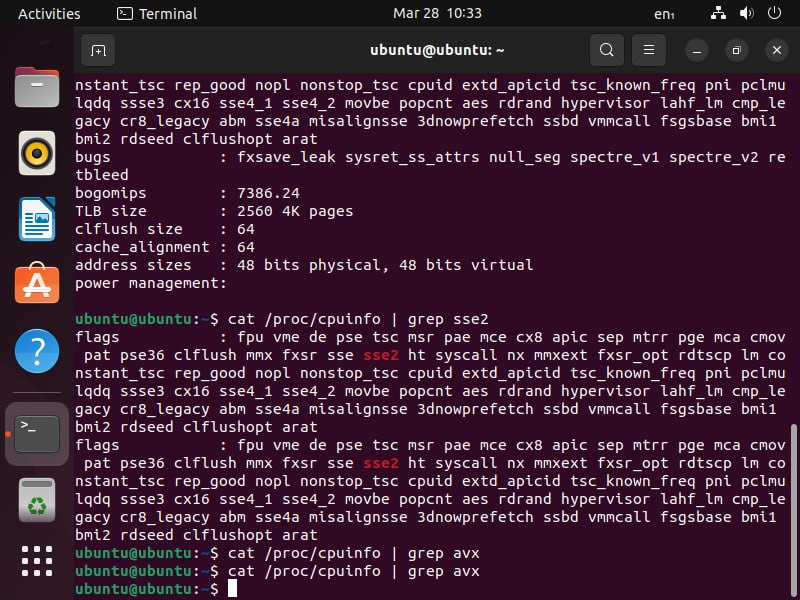
AVX is enabled on my computer, but disabled in the VirtualBox environment. So if I disable AVX in Parallels on x86-64 macOS, garbage values should be printed, right? Unfortunately I couldn’t find a way to disable AVX in Parallels, but I did find a way to disable it via kernel parameters, so I gave it a try.
Below is the result of running the problematic code in Parallels with AVX enabled.
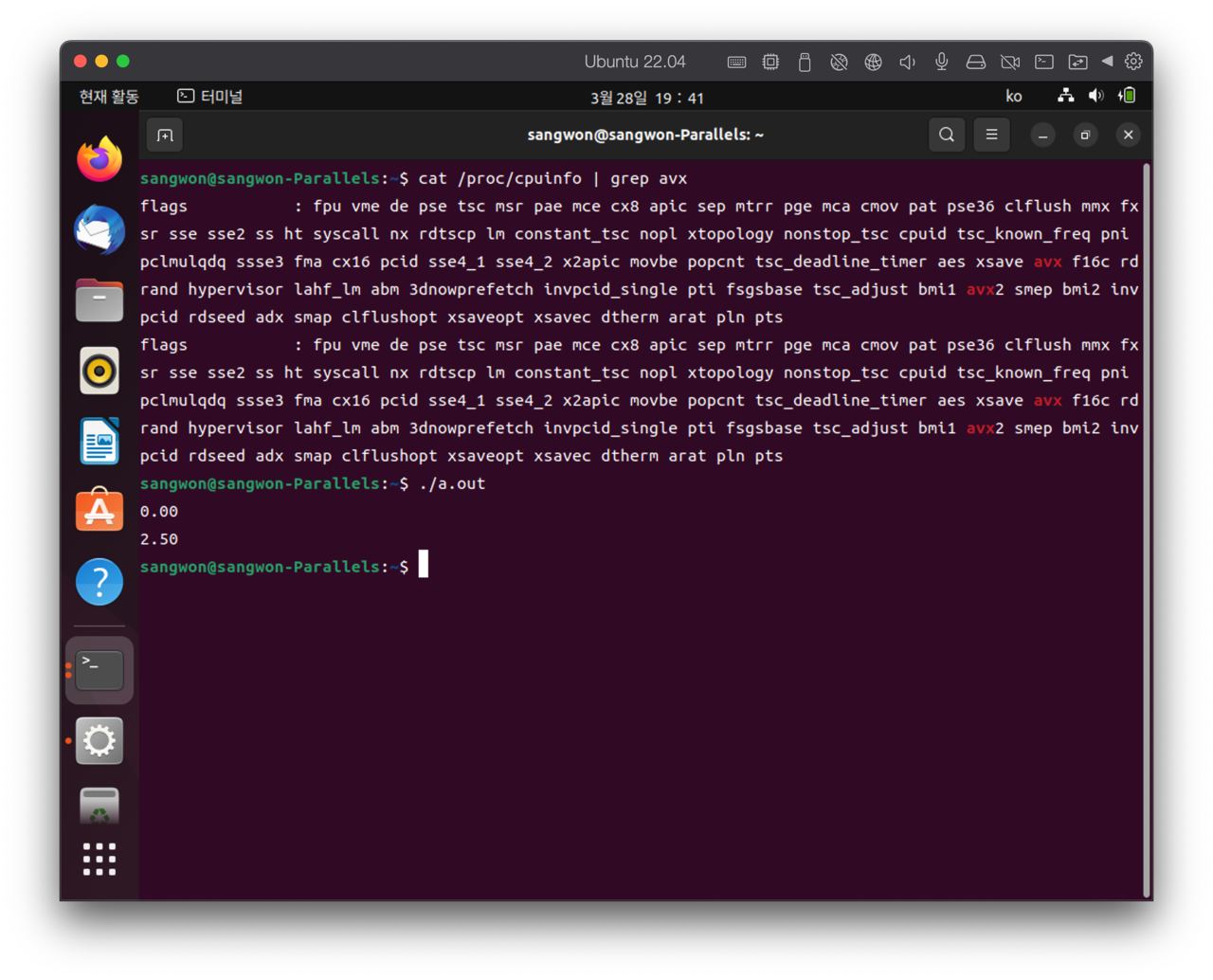
Below is the result of running the problematic code in Parallels with AVX disabled.
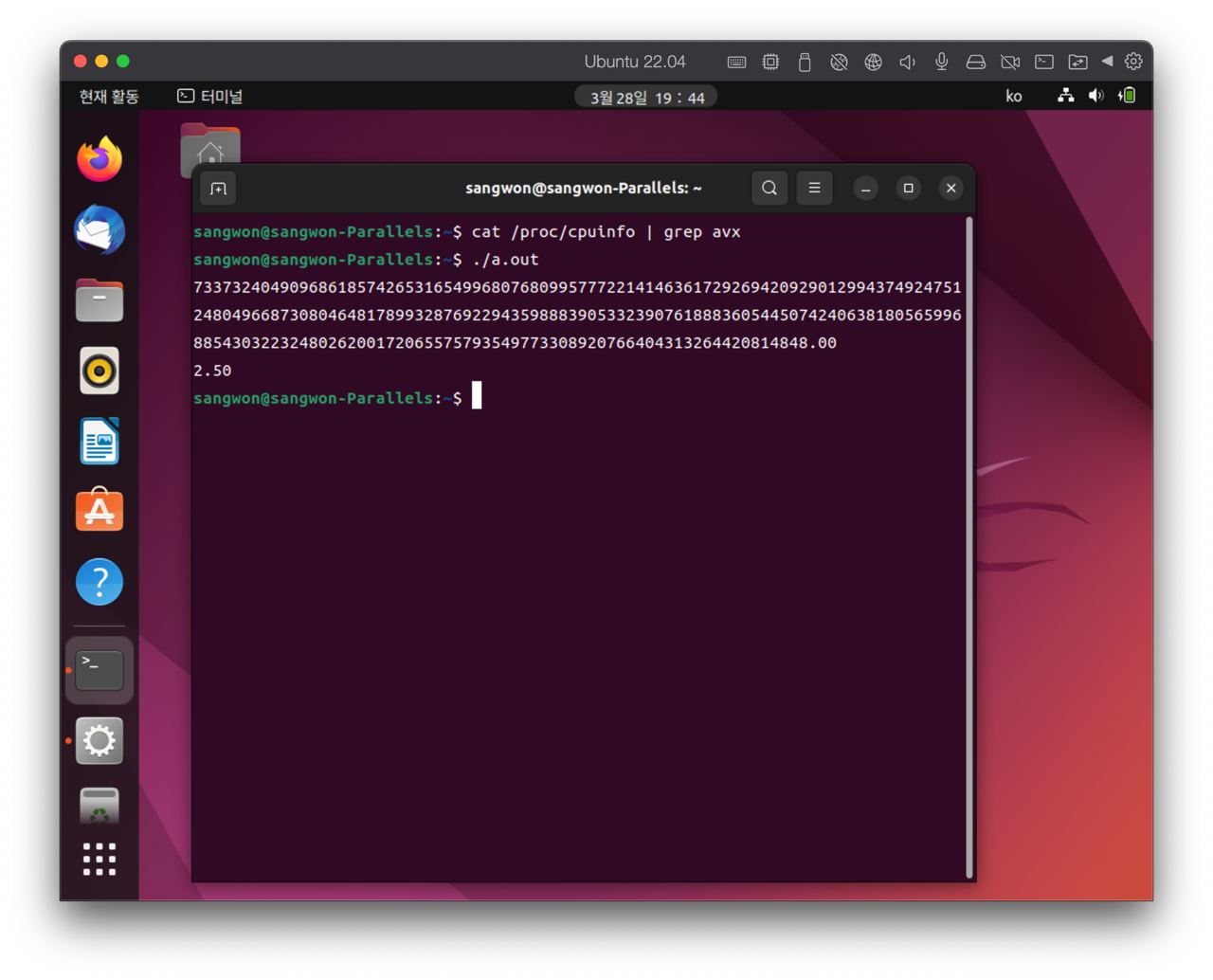
Just as expected, AVX affected the output. But why does AVX affect the result?
Googling
Since the same binary was run on both the AVX-enabled and AVX-disabled machines, I assumed it wasn’t using any instructions introduced by AVX, so I Googled for instructions that behave differently when AVX is enabled. And I stumbled upon a bizarre instruction I’d never heard of before: CVTSS2SD.
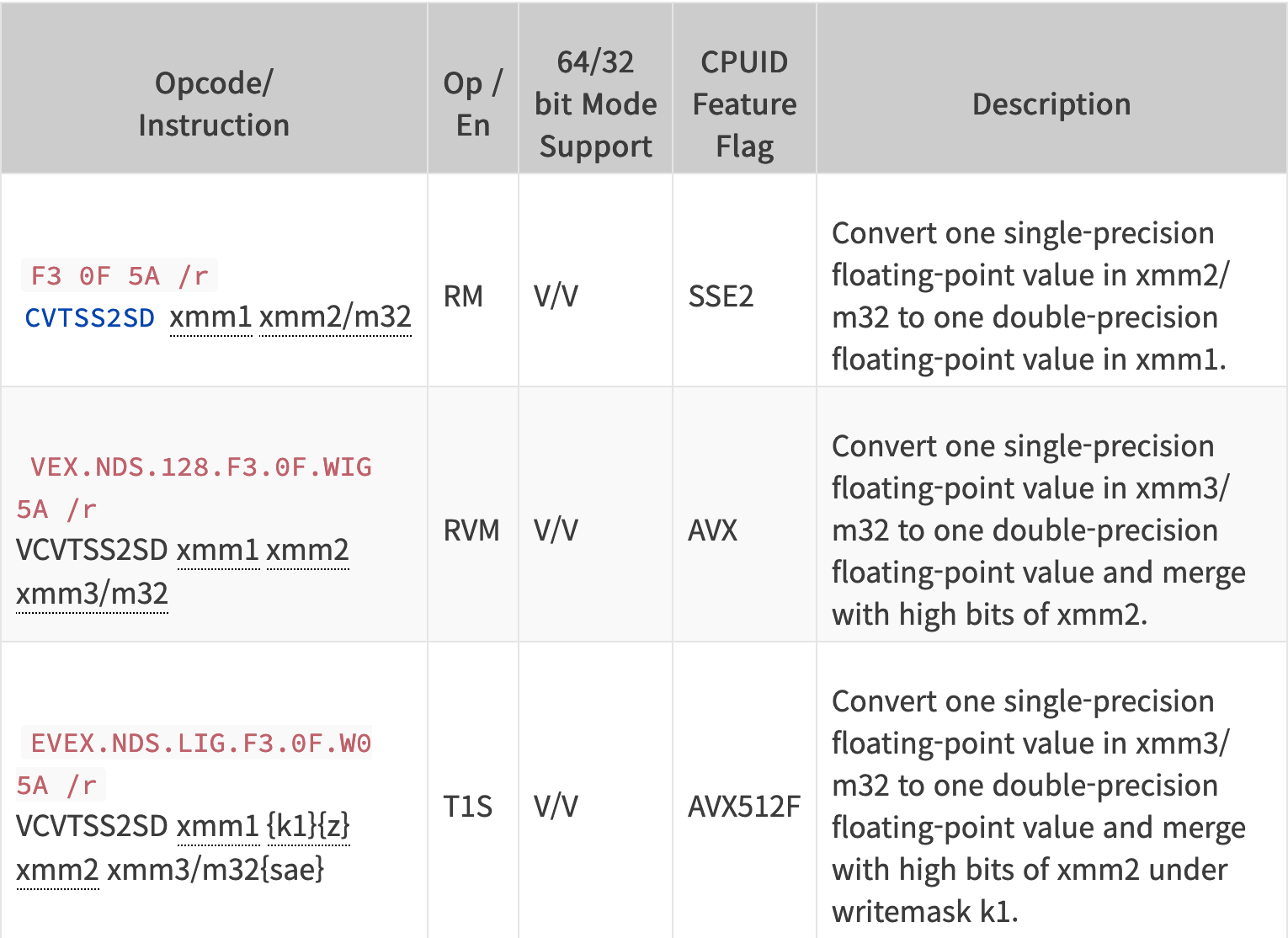
When only SSE2 is enabled, it converts the single-precision floating-point value in the xmm2 register to a double-precision floating-point value and stores it in xmm1. When AVX is enabled, it converts the single-precision floating-point value in the xmm3 register to a double-precision floating-point value and stores it in xmm2, and then zero-fills the high bits.
The Last Piece of the Puzzle
Looking at sections 6.5.2.2 Function calls and 7.15.1 Variable argument list access macros of the C99 standard document, due to default argument promotions, a float passed as a variadic argument is always converted to double. Because simply widening a float from 32 bits to 64 bits without conversion would corrupt the value, the CVTSS2SD instruction is used to perform the type conversion — and since the behaviour of CVTSS2SD differs depending on whether AVX is enabled, different values are printed in different environments. In fact…
🚧 Work in Progress…
I’ll finish this post soon!